e|———————————-
B|—7-7-7-7-6-6-6-6-4-4———–9
G|——————————-6-3——–
D|———————————-
A|———————————-
E|———————————-
e———————————–
B-9-9-9-7-7-6-6-4-4——————
G————————–6-3————–
D————————————
A————————————
E————————————
Understanding the major and minor pentatonic scales
Learn the major and minor pentatonic scales, their patterns, when to use them, and why they’re the scale shortcut.
Pentatonic Scale Name
Pentatonic scales contain five notes, which is how it gets its name (Penta=5, tonic = tones). There is a major pentatonic scale and a minor pentatonic scale. The awesome part is that they contain the same note intervals (with differing roots), so the patterns are the same. You just need to learn a new root note.
Pentatonic Scales Are the Scale Shortcut
There are a few reasons that the penatonic scales are the short cut for the scales.
- You can learn the same exact patterns for both. You just need to know how the root note changes in the pattern.
- You can play the major pentatonic scale over almost any major or dominant chord without clashing with the chord.
- You can play the minor pentatonic scale over almost any minor chord without clashing with the chord.
- Sometimes you can play both scales over the same chord, especially for a bluesy sound.
Isn’t that an exciting and simple formula for success? This is why pentatonic scales are so popular.
Play Over Major Chords
Play the major pentatonic scale over major chords.
For example, over C Major you could play the C Major pentatonic scale.
Some people claim that you can play the C minor pentatonic scale for a bluesy sound. Yes, you can, but you should be mindful of the notes you are playing. The minor pentatonic scale has a minor 3rd (or b3) while the major chord as a major third. This note can clash, but you can bend the minor third up a half step to a major third, which is a common tactic by blues guitarists.
Playing Over Minor Chords
Use the minor pentatonic scale over minor chords.
For example, play A minor pentatonic over an A minor chord.
Playing Over Dominant Chords
You can use both major and minor pentatonic scales, but once again, be cautious of the minor third when playing the minor pentatonic scale.
For example, you can play C Major pentatonic or C minor pentatonic over a C7 chord.
Dominant chords have a major third and a minor seventh (b7). The minor pentatonic scale has a minor third, which may clash with the chord’s minor third. Once again, bending the minor third up to the major third is a nice bluesy sound. In this case, the minor pentatonic scale contains the minor seventh, so that note sounds great.
The Major pentatonic scale does not have any clashing notes.
Advanced Note
If you are a fan of Jimi Hendrix, you know that he likes to play a Dominant7#9 chord. The 9 is also called the 2nd. The #9 is enharmonically the same as a minor third (b3). In other words, if you see this chord, it implies that you should play the minor pentatonic scale since it has a minor third.
Playing in a Key
I am cautiously going to make a recommendation here. Since the chords change, you can follow my rules below and be safe. All the notes should sound fine. Just remember that some notes will sound better than others depending on current chord.
In a major key, play the major pentatonic scale and its relative minor interchangably. In the key of C, you would play the C Major pentatonic scale or the A minor pentatonic scale.
In a minor key, play the minor pentatonic scale.
How to Form the Scale
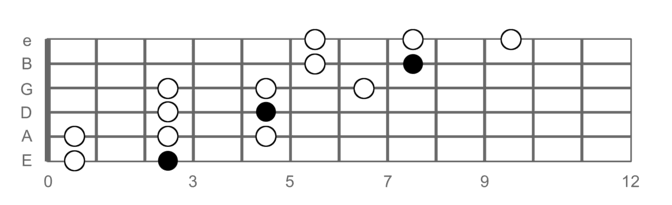
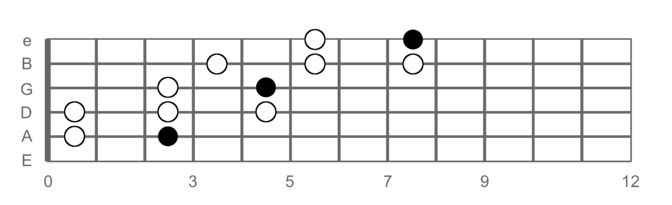
I just told you that you can use the same patterns, but the difference is where they start. For example, if you use the C Major Pentatonic Scale, the matching minor pentatonic scale is the A minor pentatonic scale. It is 3 frets or semitones down from C. If you know your relative minor scales, A is the relative minor of C. Let’s take a look at two box patterns.
Example of a Pentatonic Box Pattern – the Same Notes
Take a look at these two popular pentatonic box patterns. You’ll note that they’re the same except the root note location is 3 frets down for the minor pentatonic scale. If you’re familiar with the CAGED chords, you’ll notice that this box pattern relates to the G form and the E form respectively. I will show you the box patterns for all the CAGED forms later.
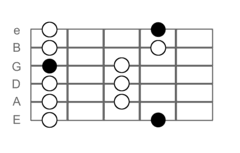
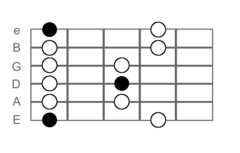
What this means is that you need to know exactly five box patterns for both scales. I will cover patterns in greater depth below.
Forming Pentatonic Scales in Parallel
Another way to form the scale is in parallel, using the same root note rather than the relative minor. In my opinion, this is useful for learning the notes of the scale rather than just the pattern. To form the scales in parallel, you can take the major scale and use the formulas in the table below.
For example, the C major scale is C-D-E-F-G-A-B. To form the C Major pentatonic scale, you would take the 1 = C, 2 = D, 3 = E, 5 = G, 6 = A. To form the C minor pentatonic scale, you would take the 1 = C, b3 = Eb, 4 = F, 5 = G, b7 = Bb. You will notice that the notes are not the same because only the relative minor pentatonic scale has the same notes. In this case, it is A minor pentatonic which is A, C, D, E, G (the same notes as C Major Pentatonic).Scale
Note Degrees (Based on the Major Scale)Major Pentatonic1-2-3-5-6Minor Pentatonic1-b3-4-5-b7
Major Pentatonic Box Patterns
These are the five CAGED box patterns for the Major Pentatonic Scale. Can you pick out the major chords associated with the forms? You’ll notice that all the chord tones are there!
G-form Box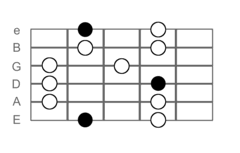
E-form Box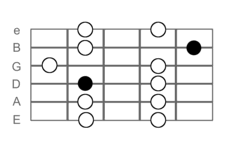
D-form Box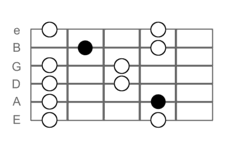
C-form Box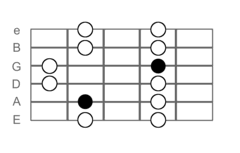
A-form Box
Minor Pentatonic Box Patterns
These are the five CAGED box patterns for the minor pentatonic scale. Notice that the root note location changes. Because the root note changes, you’ll also notice that the “chord form” changes too. The E minor box form is the same as the G Major box form. Some people avoid teaching CAGED for these boxes to avoid confusion. I think it’s best to associate the chord form, which you should know, to the proper box patterns.
E-form Box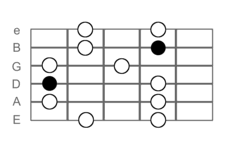
D-form Box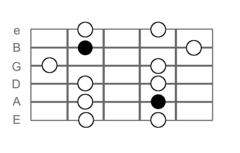
C-form Box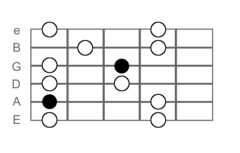
A-form Box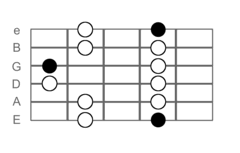
G-form Box
Single-Octave Box Patterns
Another method of learning the pentatonic box patterns is to use single octave patterns. If you know how to move single-octave box patterns around the fretboard, you can use these two patterns to simplify the learning process.
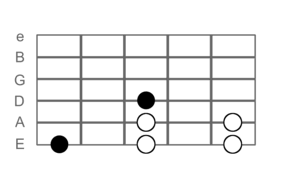
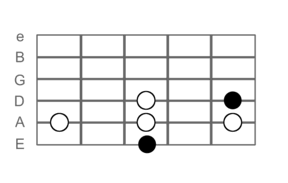
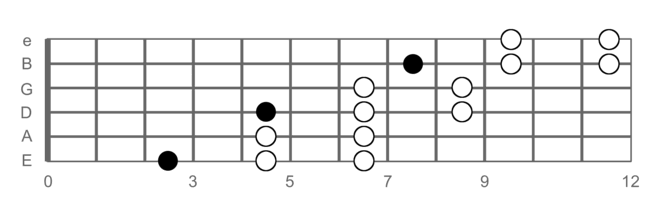
Diagonal Major Pentatonic Scale Patterns
The single-octave patterns can be linked to produce two diagonal patterns, each repeated three times. The figure below shows two diagonal major pentatonic patterns. The two combine to provide a pattern with a root on each string.
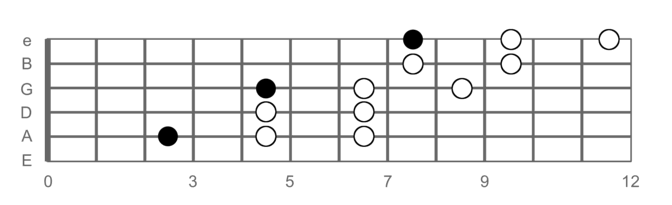
Diagonal Minor Pentatonic Scale Patterns
Similarly, the single-octave minor pentatonic pattern can be repeated to form two diagonal scales with roots on every string! Can you identify where these diagonal patterns fit the box patterns? As an exercise, I recommend finding where the box patterns fit into these diagonal scales.
Conclusion
Please if you’ve been helped by this post don’t forget to like and comment
Tips on buying your first guitar
Once you’ve made your decicion to start learning guitar, the first step will be to actually get one. At first sight, guitars have mysterious specifications and technical jargon that you won’t be able to comprehend, so it can be a daunting process for a beginner who doesn’t have a clue about anything guitar related.
To make things a bit simpler for you, here are some tips on buying the best first guitar.
1. What type of guitar is right for you?
There is a never ending debate on whether you should get an acoustic or an electric guitar as your first guitar. In short, there are 2 main categories of guitars you can choose from:
acoustic-first-guitar1. Acoustic guitars
Acoustic guitars only use acoustic means to transfer the vibrational energy of their strings to produce a sound. What basically happens is that the vibration of the string is passed on into the body of the guitar, the empty space there amplifies the resulting sound, which is let out through the soundhole.
You can subcategorize acoustic guitars further:
Nylon stringed classical guitars
Steel stringed acoustic guitars
These 2 sub-types create a totally different tone, and you play them a bit differently as well.
electric-guitar2. Electric guitars
Electric guitars use a pickup to convert the vibration of their strings into electrical impulses. This signal is sent to an amplifier, where the strength of the signal is amplified, and then sent to the loudspeaker.
There are literally thousands of different acoustic and electric guitars, so choosing one can be a bit difficult. We’ll get into the specifics of how to choose your first beginner guitar further down in the article.
Is an acoustic or electric better for beginners?
Go ahead and read this article, where you’ll find out the pros and cons of both types of guitars. Electric guitars are easier to play because of their lighter strings, but if you initially learn on an acoustic, you’ll be a better guitar player.
If you are still uncertain, ask yourself, “What kind of music do I like?”. Get the type of guitar that fits your musical taste, you can’t go wrong with that.
2. How much to spend on your first guitar?
first-guitar-priceYou can spend all the money in the world on a guitar. Trust me. Been there, done that 🙂
For your first guitar though, a reasonable amount to pay is between $200-$500.
The reason you don’t want to buy a guitar cheaper than this range is that guitars under $150-200 are mostly garbage. Sorry to be blunt, but that’s the truth. They are manufactured in Asian sweatshops, and as such, are basically low-quality firewood at best.
You could spend more than the range I recommended above, and the more you spend, the better your guitar will be. More expensive guitars are more durable, have a better tone, and are easier to play. But what if you won’t like playing? Unfortunately, lots of people quit learning guitar after a few months, and I’m sincerely hoping you won’t be one of them, but what if…
Of course, if you have the cash, there are worse ways to spend your money.
3. Where to buy it?
You might be tempted to buy your new guitar online since prices will be lower. The problem is that if you buy it online, you won’t have anyone helping you, you can’t test the guitar, and you can’t discuss your needs with an expert.
I highly suggest you buy your first guitar at a local dealer, preferably a respected guitar shop. Some of you might say,
Hey, I’ll go to the guitar shop, talk with the salesman, test all the guitars, and I’ll just buy it online in the end.
Well, you could do that, but come on… Respect the knowledge and work they put into their business, and spend that extra $30 at the shop.
In all my years playing guitar (20+), I’ve never bought a new guitar online. It’s much more fun and a better experience to buy it at the store. Other than that, you can meet other guitar players at stores, and maybe set up a joint practice session or trade tips.
4. Buying a used guitar as a first guitar
I don’t recommend this to beginners, since buying a used guitar will be a gamble. Beginners don’t know what to check on used guitars. It takes lots of experience and knowledge to be able to tell whether a used guitar is good or not.
Unless you have a knowledgeable friend who can help you out on this front, stay away from used guitars at first.
5. Accessories you will need, other than the guitar
guitar-accessoriesHere is a list of guitar accessories beginners will need. You don’t need everything on that list, the most important things are:
Electric tuner
Capo
Guitar stand
Picks
Gig bag (if you plan on taking private lessons and need to haul your guitar around)
If you end up buying a beginner guitar package, that will already include most of the things on the shopping list. I don’t really recommend buying all-in-one guitar sets, they are usually low quality and a waste of money. Think about it. They sell for $100-$200, you can’t possibly include everything for that price, and have it be decent quality.
It’s better, and more fun to choose the things you need yourself. It will cost a bit more, but it’s worth it.
6. Knowing all the above, how do you pick the actual guitar?
Ok, so this is where the fun begins. You walk into a guitar shop, take a deep breath, take in that new guitar smell. It’s like drugs for guitarists.
Find yourself a sales clerk, and tell him/her why you’re there. Then head on over to the acoustic or electric guitar section, and start looking around. If any guitar catches your eye, ask the salesman to take it down for you. It is very important to choose a guitar which is aesthetically pleasing for you, so one which you find beautiful. The more you fall in love with the guitar, the more you’ll be enticed to play it at home.
guitar-store-clerks
Ask the store salesman to:
Make sure it’s in tune;
Tell you a bit about the guitar;
Play the guitar a bit.
Sit down and grab the guitar, put it into playing position, see how it feels. Obviously, you won’t be able to play it, you just want to see how holding it feels. If the body of the guitar is too big or too small, it will feel awkward.
You’ll know you’re on the right track if you get goosebumps, I always do with a new guitar that I’m going to buy 🙂
Now put the guitar back, grab your salesman, and make him show you a few more beginner guitars, repeating the above. Don’t be afraid to spend a lot of time at the store, there’s no rush.
7. Get your new guitar set up at the store
guitar-setupOnce you’ve selected your new baby, you’ll want to ask the salesman to get it set up for you. Most guitar stores have a luthier or someone who does guitar setups, which will cost $25-50 extra.
Why do you need to setup a new guitar? Good question!
When a lower-end guitar ships from the factory, it is not set up optimally. The fret edges might be sharp, the action too high, the intonation off, etc.
When you have your guitar set up, you’re getting all of these things checked and fixed, plus new strings, so your guitar will play better. This is really important not just for beginners, but for players of all levels.
8. Learning to play your guitar
So you have your new beauty, it’s set up correctly, and sitting on the stand in your room. Now what?
1. Personal lessons
The best, and most expensive way to learn guitar. A lesson typically costs $50, so having 2 lessons per week will set you back $5200 per year.
2. Teach yourself guitar
The internet is flooded with guitar lessons. Find a course that you stick with, don’t just jump around random YouTube videos, that will actually inhibit the learning process, since it lacks structure.
I have a detailed free guide for beginner guitarists, that will take you from zero to I can also recommend GuitarTricks or JamPlay, they are both quality websites. They cost around $120 per year, well worth your money for the amount and quality lessons you get.
 Everythinguitar